

Quick Answer
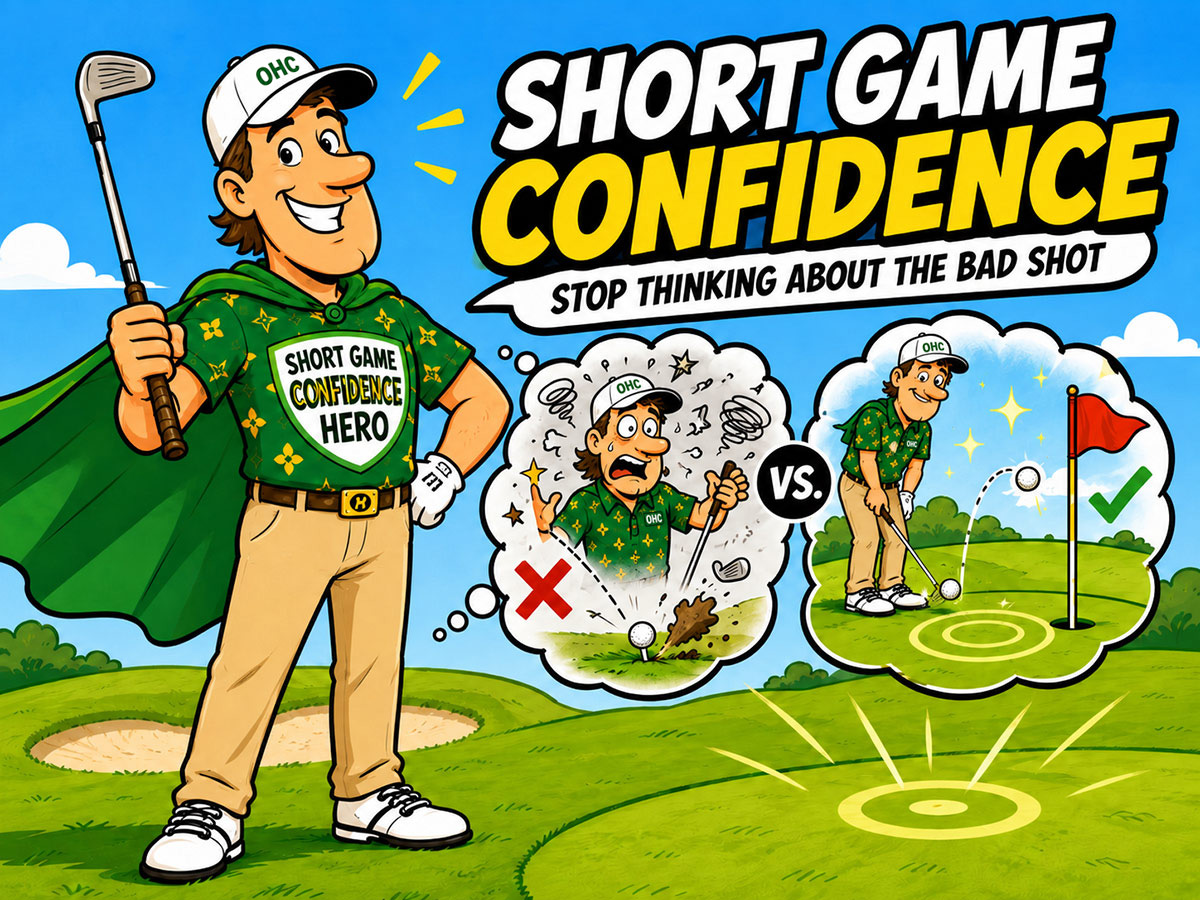
To stop thinking about the bad shot in golf, give your brain a clear positive target, use one simple swing cue, and commit before you step into the ball. The goal is not to “hope” you hit a good chip. The goal is to tell your mind exactly what to do, then swing with conviction.
Because around the green, fear is expensive.
Chunk one chip and you lose a stroke. Blade one across the green and you lose two strokes, your dignity, and possibly your will to speak during the cart ride.
The Most Dangerous Thought in Golf
Here is the thought that ruins more short game shots than bad technique:
“Don’t mess this up.”
That one sentence is poison.
The second you think “don’t chunk it,” your brain hears chunk it.
The second you think “don’t blade it,” your brain starts loading the blade movie in HD.
And the second you think “please don’t embarrass me in front of Steve,” Steve is already licking his chops, ready to say, “You picked your head up,” even though Steve shot 97 and three-putted from eight feet.
This is where short game confidence starts. Not with magic. Not with pretending you are fearless. Not with whispering affirmations into your wedge like it is a rescue puppy.
It starts with learning how to aim your attention.
Research on self-talk in sport supports the idea that the words athletes use can help direct attention, improve learning, and enhance performance. A meta-analysis on self-talk and sport performance found that self-talk interventions can be effective, especially when used intentionally as part of training. (PubMed)
In plain golfer English:
Your brain needs instructions. Give it useful ones.
Why Bad Shots Stick in Your Head
Golfers have a memory problem.
We forget the five decent chips we hit on the front nine, but we remember the one nuclear missile we launched over the 12th green like it was a crime scene.
That is because golf is emotional. Bad shots feel louder. A chunk has trauma. A blade has drama. A double bogey has paperwork.
The short game is especially brutal because the motion is small, the target is close, and everyone can see what happened. There is no mystery. If you hit your driver into the trees, you can blame the wind, the shaft, the tee height, your lower back, or your buddy talking in your backswing.
But when you chunk a 12-yard chip?
Everyone saw it go 14 inches.
That is why you need a mental system.
Not a 45-minute meditation routine. Not a sports psychologist hiding in your golf bag. Just a simple plan you can use before every chip.
Positive Thinking Is Not Fake Thinking
Let’s clear something up.
Positive thinking does not mean standing over a fried-egg lie in a bunker and saying, “I am basically Tiger Woods.”
No, you are not. You are a guy with a wedge, a bad lie, and three people waiting on the tee behind you.
Positive thinking means you choose a useful thought over a destructive one.
Bad thought: Don’t blade it.
Better thought: Brush the grass and land it on that spot.
Bad thought: I always stink from here.
Better thought: Simple setup. Smooth motion. Finish forward.
Bad thought: If I mess this up, my round is dead.
Better thought: Get it on the green and give myself a putt.
That is not fantasy. That is performance thinking.
Mental imagery and visualization are also widely used in sport because they help athletes mentally rehearse actions before performing them. Recent research on imagery practice suggests it can support confidence and self-efficacy, which are important parts of athletic performance under pressure. (Frontiers)
So yes, you can “manifest greatness” in golf.
But not by wishing the ball close.
You manifest greatness by seeing the shot, choosing the shot, committing to the shot, and then swinging like a golfer who has paid the greens fee and deserves to enjoy himself.
The Classic Short Game Mental Breakdown
Here is what most golfers do around the green.
They walk up to the ball. They see the bunker. They see the water. They see the downhill slope. They see the tight lie. They see their buddies watching.
Then their brain turns into a courtroom drama:
Brain: “Remember when you bladed this exact shot in Myrtle Beach?”
Ego: “Yes, but that was because the grass was weird.”
Hands: “Should we flip at it?”
Eyes: “Let’s look up early and see if it worked.”
Body: “I have decided to freeze.”
Wedge: “I would like to be traded.”
Then they make a nervous jab at the ball and act shocked when the result is bad.
That is not a technique problem alone.
That is a mental traffic jam.
The Real Goal: Replace Fear With a Job
A confident chipper does not stand over the ball trying to avoid disaster.
A confident chipper gives the ball a job.
The job might be:
Land on that brown leaf.
Carry the fringe.
Release like a putt.
Clear the bunker and stop near the fat part of the green.
The more specific the job, the quieter your brain becomes.
This is where a pre-shot routine matters. Research on pre-performance routines in sports defines them as task-relevant thoughts and actions an athlete uses before execution, and meta-analysis evidence supports their effectiveness for performance, including under pressure. (Taylor & Francis Online)
For golfers, a routine is not superstition.
It is your mental seatbelt.
The OHC 3-Step Mental Approach
I will not guarantee every chip finishes tap-in close. Anyone who guarantees that is either lying, selling a miracle wedge, or has never played municipal golf on punched greens.
But I will guarantee this:
If you use this 3-step routine, you will give your brain a better command than fear.
And that alone will help you hit more committed, confident short game shots.
Step 1: See the Movie
Before you step in, see the shot.
Not the bad version.
Not the chunk.
Not the blade.
Not the sad version where the ball rolls into a bunker and you start questioning every life decision since 1994.
See the shot you want.
See the landing spot.
See the first bounce.
See the roll.
See the ball finishing near the hole.
Make it simple:
“Land it there. Roll it there.”
That is the movie.
Your brain performs better when it has a picture. Do not give it a horror film. Give it a golf shot.
Step 2: Say the Command
Now give yourself one clear cue.
Not seven swing thoughts. Seven swing thoughts is not coaching. It is a hostage situation.
Pick one.
Good short game cues:
Brush the grass.
Quiet hands.
Land it on the spot.
Finish to the target.
Smooth and simple.
One hand. Better feel.
For one-handed chipping, I love:
Feel the clubhead.
That cue is simple, clean, and athletic. It keeps you from steering the ball like you are backing a boat trailer into a lake.
Research on self-talk suggests that instructional self-talk can help athletes focus attention on useful performance cues. (PubMed)
That is exactly what this is.
One cue. One job. One shot.
Step 3: Step In and Go
This is where golfers ruin everything.
They do the practice swing.
They pick the landing spot.
They feel pretty good.
Then they stand over the ball for 11 seconds and let the demons back in.
Nope.
Once you step in, go.
Your routine should feel like this:
Look.
Feel.
Step in.
Go.
No committee meeting.
No second-guessing.
No emergency grip change.
No last-second thought like, “Maybe I should use a 58 instead.”
You already chose the shot. Now execute the shot.
That is where confidence is built.
Not because you know the result will be perfect, but because you know you gave the shot a clear, committed swing.
The 3-Step Routine in One Line
Here it is:
See it. Say it. Swing it.
That is your new short game mental routine.
See it: picture the shot.
Say it: give yourself one positive cue.
Swing it: step in and go.
Simple.
Which, by the way, is usually better than complicated.
Complicated is how golfers end up changing wedges, grips, stances, ball position, breathing patterns, and religious affiliations between the cart path and the fringe.
What to Think Before a Tough Chip
Here are a few examples.
Tight lie
Bad thought: Don’t skull it.
Better thought: Clip the grass. Finish low.
Ball sitting down in rough
Bad thought: This is buried. I hate this.
Better thought: Steeper hit. Get it out. Give myself a putt.
Downhill chip
Bad thought: This is going to run forever.
Better thought: Land it soft. Let it release.
Short-sided over a bunker
Bad thought: I am dead.
Better thought: Big target. Soft landing. Accept 10 feet.
That last one is important. Short game confidence does not mean you aim at every flag like a maniac.
Confidence also means knowing when the smart shot is the bigger target.
A confident golfer is not always aggressive.
A confident golfer is committed.
Manifesting Greatness Around the Green
Let’s talk about “manifesting” in golf.
Manifesting greatness does not mean you stare at the hole and spiritually command the ball to obey.
Although if that works for you, please send video.
Real golf manifesting is this:
You decide who you are before the shot.
Are you the golfer who panics?
Or are you the golfer who picks a spot and commits?
Are you the golfer who tells himself, “I always mess these up”?
Or are you the golfer who says, “I have a shot for this”?
Identity matters.
The more you repeat a confident routine, the more you start becoming the kind of golfer who expects a decent result.
That does not mean every chip is perfect.
It means the panic starts losing power.
The Secret Is Not Eliminating Fear
Great golfers still get nervous.
Good players still feel pressure.
Nobody stands over a downhill chip to a tucked pin and thinks, “Ah yes, serenity.”
The difference is that better players do not let fear choose the swing.
They acknowledge the shot, pick the plan, and commit.
Even research on “quiet eye” training in golf suggests that training attention as part of a pre-shot routine can help golfers maintain control when anxious. In one study, golfers who received quiet-eye training improved putting performance on the course compared with controls. (PMC)
That matters because anxiety narrows attention.
A routine redirects it.
Your New Short Game Rule
From now on, you are not allowed to stand over a chip without a target and a cue.
No more “just get it close.”
That is not a plan.
That is a wish wearing golf shoes.
Use this:
Landing spot: where the ball lands.
Cue: what your body does.
Commitment: step in and go.
Example:
Landing spot: three feet onto the green.
Cue: brush the grass.
Commitment: one-handed feel, finish forward.
Now you have a shot.
Final Thought: The Ball Can Smell Fear
Okay, not literally.
But it sure feels like it.
The ball knows when you are begging. The wedge knows when you are steering. The ground knows when you are decelerating. Your buddies definitely know when you are about to do something weird.
So stop begging.
Stop thinking about the bad shot.
Give your brain a better job.
See it. Say it. Swing it.
That is short game confidence.
That is how you start hitting chips with more freedom, more feel, and a lot less panic.
And if all else fails?
Go one-handed.
It is not magic.
It is just simpler.
Frequently Asked Questions
How do I stop thinking about bad golf shots?
Replace the bad-shot thought with a specific task. Instead of thinking “don’t chunk it,” pick a landing spot and use one positive swing cue like “brush the grass” or “finish to the target.”
What should I think about before a chip shot?
Think about where the ball should land, how it should roll, and one simple cue for the motion. A good routine is: see it, say it, swing it.
Does positive thinking really help golf?
Positive thinking helps when it is specific and useful. Telling yourself “I am amazing” is not enough. Giving yourself a clear cue like “land it on that spot” or “smooth and simple” helps direct attention and reduce panic.
Why do I panic on short chip shots?
Short chips create pressure because the target is close and the miss is obvious. Many golfers focus on the mistake they fear instead of the shot they want. A simple pre-shot routine can help redirect attention.
What is the best mental routine for chipping?
Use the OHC 3-step routine: See it. Say it. Swing it. Visualize the shot, say one positive cue, then step in and hit it without second-guessing.
