

Quick Answer
Yes, a small golf hack like Golf Gum can help your mental game if you use it the right way. It will not fix a bad swing, cure a slice, or make your wedge magically obey you like a trained golden retriever. But caffeine can support alertness and attention, and chewing gum can become a simple focus trigger during your round.
And in golf, focus matters.
A lot.
Because the difference between a good chip and a complete short-game crime scene is often one tiny lapse in attention.

Golf Is a Focus Sport Disguised as a Walking Sport
Golf looks peaceful from a distance.
Birds chirping. Fresh-cut grass. A little breeze. A group of adults dressed like they lost a bet at a country club.
But inside the golfer’s mind?
Chaos.
One minute you are thinking, “Smooth tempo. Pick a landing spot.”
The next minute you are thinking:
“Did I leave the garage door open?”
“Why is my buddy standing there?”
“Is this a 56 or a 60?”
“Do I look weird doing this one-handed?”
“Please don’t chunk this in front of the beverage cart.”
And now your brain has left the golf course.
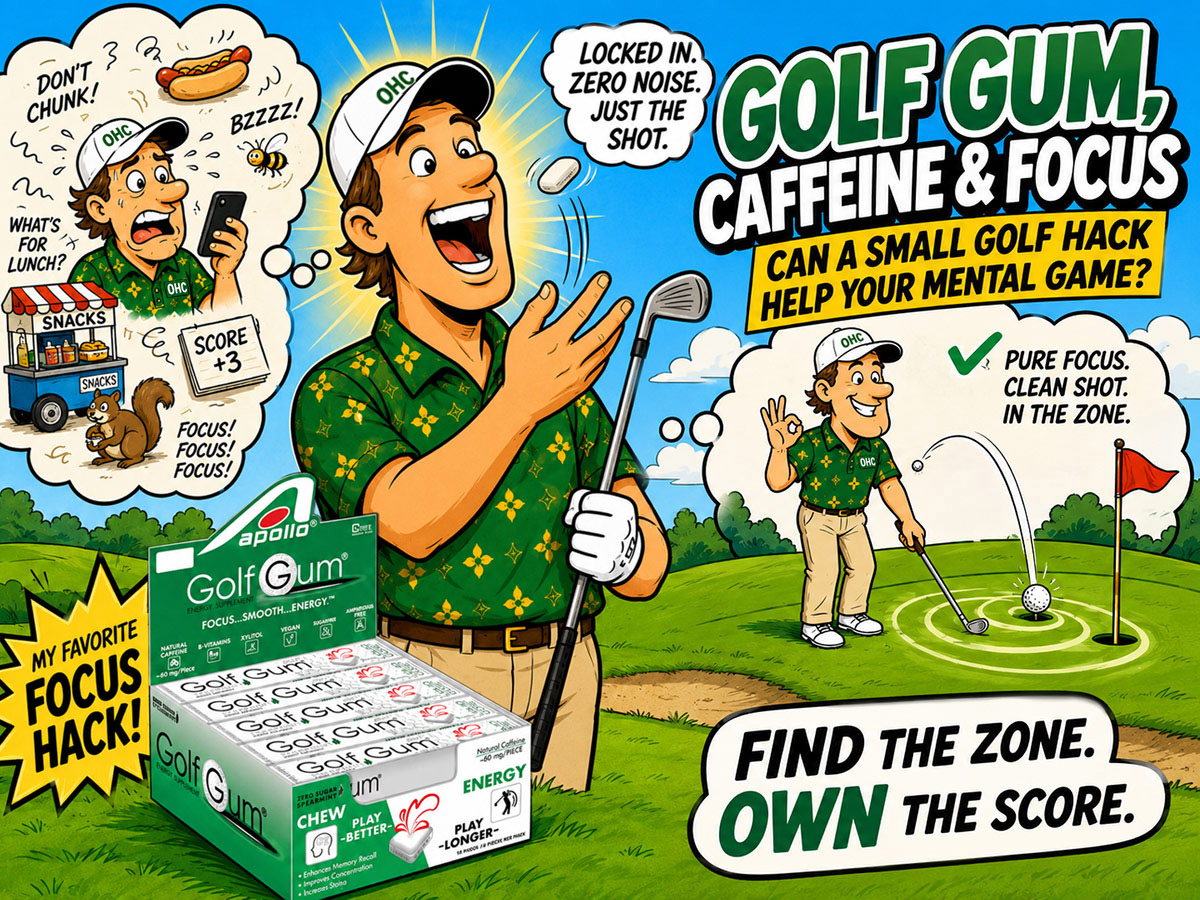
Your body is standing over a chip shot, but your mind is somewhere between your mortgage payment and the hot dog at the turn.
That is why focus is so important in golf. You only need to lose it for one second to turn a simple chip into a shovel pass.
Why Focus Around the Green Is Everything
The short game is where golfers get exposed.
With a driver, you can swing hard and blame technology.
With an iron, you can blame wind.
With putting, you can blame spike marks, grain, ghosts, or “these greens are impossible.”
But with a chip from 12 yards?
Everybody knows.
You either picked the right shot, committed to it, and brushed the grass…
Or you panicked, stabbed at it, and sent the ball either 3 feet or 43 yards.
Short game focus comes down to three things:
- Choosing the shot.
- Committing to the shot.
- Staying present long enough to hit the shot.
That third one is where a lot of golfers fall apart.
The Classic Golf Focus Meltdown
Here is a very common scene.
You are just off the green. The lie is decent. Nothing scary. You have a simple chip.
Then your brain starts talking.
“Don’t chunk it.”
“Don’t blade it.”
“You did this last week.”
“You should probably use the 60.”
“No, use the 52.”
“Actually, maybe putter.”
“Why are my hands sweating?”
“Is Jim watching?”
Then you make a nervous little swing that looks like you are trying to defuse a bomb with a butter knife.
That is not focus.
That is mental static.
Great short-game players reduce the noise. They do not need 17 thoughts. They need one clear job.
Land it there. Roll it there. Finish balanced.
Simple.
Which, by the way, is the whole point of OneHandedChipping.com.
It is not magic.
It is just simpler.
Where Golf Gum Comes In
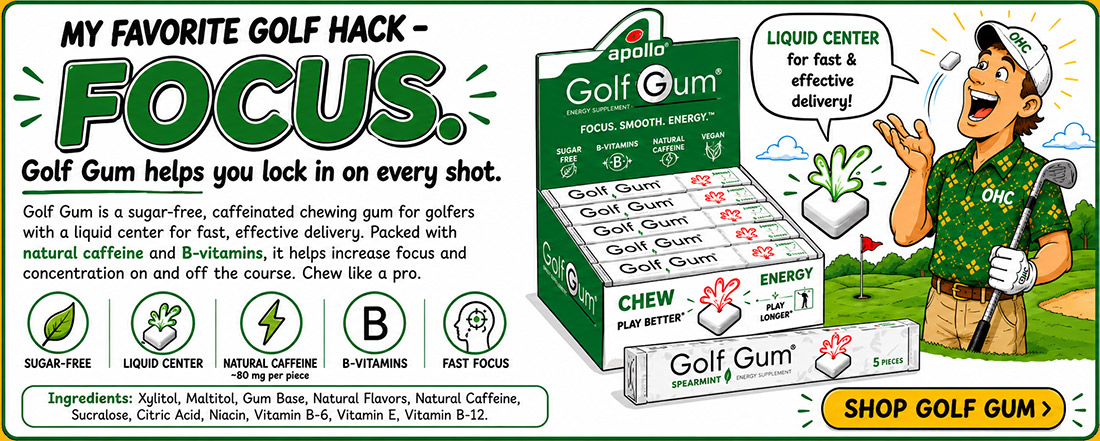
My favorite little focus hack on the course is Golf Gum.
Why?
Because it is easy. It is portable. It is golf-specific. And it gives me a small pre-shot mental anchor.
Golf Gum’s product page says each piece contains about 80 mg of natural caffeine plus B vitamins, and the company describes it as sugar-free and designed for golfers who want convenient energy and focus on the course. (Liquid Core Store)
That 80 mg number matters because it is not “I drank three gas station energy drinks and can now hear colors” caffeine.
It is more like a small cup of coffee.
Enough to feel awake. Not enough to make you read every putt like you are negotiating a peace treaty.
The Science: Caffeine and Focus
Caffeine is not just a morning personality replacement. It can support attention.
A 2025 systematic review and meta-analysis found that acute caffeine intake can improve attention by improving reaction time and accuracy, although higher doses can keep improving reaction time while accuracy eventually stops improving or may decline past certain thresholds. (PubMed)
Translation for golfers:
A little caffeine can help you feel sharper.
Too much caffeine can turn you into a squirrel with a wedge.
And nobody wants that.
Caffeine gum is also interesting because it may absorb faster than capsules. A study comparing caffeinated gum with capsules found that caffeine from gum was absorbed significantly faster, possibly through the lining of the mouth, while 100 mg and 200 mg gum doses provided similar total caffeine exposure to capsules. (PubMed) A 2024 review on caffeinated chewing gum and exercise performance also concluded that low-dose caffeine gum, around 100 to 300 mg or 2 to 4 mg/kg, is rapidly absorbed and can positively affect many performance measures. (PMC)
That does not mean Golf Gum will make you a tour player.
It means it can be a smart little tool in your golf bag.
Right next to your tees, glove, ball marker, and the emotional support ball you refuse to retire even though it has seen things.
The Real Benefit: A Focus Trigger
Here is where I think Golf Gum really helps.
It is not just the caffeine.
It is the ritual.
When you chew a piece before the round or when you feel your focus fading, it becomes a signal:
Okay. Reset. Lock in. Play smart.
That is powerful.
Good golfers have triggers. They use routines. They find ways to return to the present.
Golf Gum can become part of that.
Not as a superstition. Not as a magic pellet.
As a cue.
Chew. Breathe. Pick the shot. Commit.
That is a good golf brain.
How to Find the Zone in Golf
Every golfer talks about “the zone.”
The zone is that magical place where the game feels slower, your swing feels natural, your touch feels better, and you stop trying to impress your friends with a flop shot you have no business attempting.
The zone is not forced.
You do not find the zone by saying, “I need to be in the zone now.”
That is like trying to fall asleep by yelling, “SLEEP HARDER.”
The zone usually comes from having a simple process and staying with it.
Here is what the zone feels like in the short game:
You see the landing spot.
You know the club.
You feel the swing.
You are not thinking about the last shot.
You are not thinking about the score.
You are not thinking about the guy in your group who gives swing advice but cannot break 92.
You are just in the shot.
That is the goal.
The OHC Focus Formula
Here is my simple golf focus formula:
Energy + Routine + Simplicity = Better Decisions
Golf Gum can help with the energy part.
Your pre-shot routine handles the routine part.
One-handed chipping handles the simplicity part.
That is why I like it.
When you are focused and your technique is simple, you stop feeling like every chip is a courtroom trial.
You just pick a landing spot and go.
When Focus Usually Breaks Down
Golfers rarely lose focus in obvious ways.
It is usually small leaks.
Focus Leak 1: You rush the first tee
You show up six minutes before your tee time, leap out of the car, tie one shoe, spill coffee on your shirt, and hit your opening tee shot while still mentally finding your wallet.
That is not a warmup.
That is a hostage rescue.
Focus Leak 2: You start score-watching
You are playing well, then suddenly you think, “Wait… I could shoot 79.”
And now 79 is no longer a goal.
It is a monster hiding in the cup.
Focus Leak 3: You let one bad shot become a personality crisis
One chunked chip does not mean you are bad at golf.
It means you hit one bad chip.
Golfers love turning one mistake into a documentary.
Focus Leak 4: You play too slowly
Slow golf kills rhythm.
The longer you stand there, the more your brain starts offering suggestions. Most of them are terrible.
Golf is best when you play with rhythm. Not rushed. Not frantic. Just ready.
Focus Leak 5: You get tired on the back nine
Mental fatigue is real. The first seven holes feel like golf. Holes 14 through 18 can feel like a hostage negotiation with your own attention span.
That is where a small focus tool like Golf Gum can help some golfers feel more alert and engaged.
My Favorite Golf Gum Strategy
Here is how I would use it.
Before the round:
Chew one piece about 10 to 15 minutes before teeing off, especially if you feel flat or mentally foggy. Golf Gum’s own product guidance recommends chewing a piece roughly 10 minutes before tee-off, and another later if fatigue sets in. (Liquid Core Store)
During the round:
Use it as a reset tool. If your focus starts drifting on the back nine, chew a piece and recommit to your routine.
Around the green:
Use the chewing rhythm as a reminder to slow your brain down.
Not your pace.
Your brain.
A golfer should play fast but think clearly.
The OHC 3-Step Focus Routine
Use this before chips, wedges, and any shot where your brain starts acting like a bad podcast.
Step 1: Pick One Job
Do not stand over the ball with vague hope.
Pick one job.
Examples:
Land it on that spot.
Carry the fringe.
Roll it like a putt.
Brush the grass.
Get it on the green and give yourself a putt.
One job. Not nine.
Step 2: Lock One Cue
Pick one swing cue.
For one-handed chipping, my favorite is:
Feel the clubhead.
That is it.
Not “keep the wrist angle, rotate the chest, weight left, don’t decel, look at the front dimple, remember that YouTube guy.”
No.
Feel the clubhead.
Simple wins.
Step 3: Swing Before the Committee Arrives
Once you step in, go.
The longer you wait, the more the mental committee shows up.
And the mental committee is full of people who have never broken 100.
Step in.
Look.
Feel.
Swing.
That is the whole meeting.
Can Golf Gum Help You Stay in the Zone?
It can help, but only if you use it the right way.
Golf Gum is not the zone.
It is a tool that may help you stay alert enough to find your routine, keep your energy steady, and avoid drifting mentally.
Think of it like a caddie for your attention.
It does not swing the club.
It just taps you on the shoulder and says, “Hey, genius. Pick a target.”
That is valuable.
A Smart Caffeine Note
Because I am not trying to turn golfers into over-caffeinated raccoons, here is the practical caution.
The FDA says that for most adults, up to 400 mg of caffeine per day is an amount not generally associated with dangerous effects, but individual sensitivity varies. (U.S. Food and Drug Administration) MedlinePlus also notes that too much caffeine can cause shakiness, insomnia, headaches, dizziness, fast heart rate, anxiety, and dependence. (MedlinePlus)
So use common sense.
Do not stack Golf Gum on top of three coffees, an energy drink, and a pre-workout unless your goal is to putt with sonar.
And do not use caffeine late in the day if it messes with your sleep.
Bad sleep ruins tomorrow’s golf faster than a bad grip.
Who Might Love Golf Gum?
Golf Gum may be a good fit for golfers who:
Feel sluggish on the first tee
Lose focus late in the round
Want a cleaner option than sugary energy drinks
Like having a simple pre-shot reset
Need a little mental spark without carrying a thermos of coffee in the cart
Enjoy golf hacks that actually make sense
It is also great for the golfer who says, “I just need something small to help me lock in.”
That is exactly how I think about it.
Who Should Be Careful?
Be careful with caffeine if you are sensitive to it, have heart rhythm issues, high anxiety, sleep problems, blood pressure concerns, or have been told by your doctor to limit caffeine.
Also, if caffeine makes your hands shaky, do not take it right before delicate wedge shots.
A shaky golfer with a lob wedge is not a golfer.
That is a landscaping threat.
Final Thought: Focus Is a Skill
Most golfers think focus is something you either have or do not have.
Wrong.
Focus is a skill.
You train it.
You trigger it.
You protect it.
Golf Gum is one small tool that can help. It gives you a little energy, a little ritual, and a little reminder that you are here to play golf with intention.
The real secret is not the gum by itself.
The secret is what you pair it with:
A landing spot.
A simple cue.
A committed swing.
A better attitude.
A smarter short game.
So yes, I like Golf Gum.
It is my favorite golf focus hack.
Not because it guarantees birdies.
Because it helps me feel ready, alert, and locked in.
And in golf, that matters.
Especially when you are standing over a chip and your brain starts whispering:
“Don’t chunk it.”
Chew. Breathe. Pick the spot.
Then go one-handed.
It is not magic.
It is just simpler.
Frequently Asked Questions
Can Golf Gum help my golf focus?
Golf Gum may help support focus because it contains caffeine, and caffeine has been shown to improve attention, reaction time, and alertness in many people. It works best when combined with a simple pre-shot routine.
How much caffeine is in Golf Gum?
Golf Gum’s product page says each piece contains about 80 mg of natural caffeine plus B vitamins. (Liquid Core Store)
Is caffeine good for golf?
Caffeine can help some golfers feel more alert and focused, but too much can cause shakiness, anxiety, or poor sleep. Use a moderate amount and pay attention to how your body responds.
When should I use Golf Gum during a round?
A simple approach is one piece before tee-off or when your focus starts fading, such as on the back nine. Avoid using too much caffeine, especially late in the day.
What is the best focus routine for golf?
Use this 3-step routine: Pick one job, lock one cue, swing before the committee arrives. In other words, choose your landing spot, use one simple swing thought, then step in and go.